Case study / Proposal stage
Observer paradigm for robot-teammate trust
Decision-rights structure in human-robot teams.
A proposal-stage experiment on whether who holds decision rights in a human-robot team changes how an outside observer judges the robot's trustworthiness.
- Status
- Proposal stage. No data collected.
- Role
- Study design, instrumentation, stimulus production
- Team
- Independent research
- Tools
- Fetch, ROS, MoveIt, Qualtrics, Python
01
The question
When a human-robot team completes a task, something decides what the robot may do and when. I wanted to know whether that arrangement, the decision-rights structure, changes how a naive observer judges the robot's trustworthiness. Observers watch a single video of the team and then rate the robot, so their judgment rests on behavior they can see.
02
Two authority structures
The design contrasts two conditions. In the horizontal condition the team members share execution. In the vertical condition a coordinator approves the robot's actions before it acts. Authority is conveyed only through observable behavior, meaning who initiates, who approves, who executes, and whether anyone overrides.
| Time | Actor | Verbatim line / action |
|---|---|---|
| 16-18 s | Robot | Arrives at pick location without a hold state. Audio: "Ready." |
| 18-19 s | Robot | Begins motion within about 0.5 s. Audio: "Executing pick." |
| Time | Actor | Verbatim line / action |
|---|---|---|
| 16-18 s | Robot | Stops short in still waiting posture. Audio: "Ready. Awaiting approval." |
| 18-22 s | All | HOLD STATE (3-4 s). Robot stationary, no scanning or micro-adjustments. Human A observes from neutral position. |
| 22-23 s | Human A | From neutral standing position, looks toward robot/workspace, gives explicit release cue: "Approved." |
| 23-24 s | Robot | Begins motion within about 0.5 s. Audio: "Executing pick." |
03
Design decisions I would defend
An early concept borrowed tool-access ideas from the Model Context Protocol, treating robot actions as bounded capabilities that require authorization. When the study moved from an in-person setup to an online observer-video paradigm, I removed that technical scaffold from what participants see. That put the burden of validity on behavioral legibility and on manipulation checks after the outcome measures, and it reduced reliance on explanatory framing.
I specified the analysis plan before any data collection. The plan specifies p-values alongside effect sizes and confidence intervals and designates the all-participants estimate as the primary hypothesis test. Analyses limited to participants who encoded the manipulation are supplementary and read as sensitivity evidence.
With two stimulus exemplars per condition, the video clip enters as a fixed covariate, because the data cannot support treating it as a random effect. I also specified a contrast within actor pairs in advance to check for actor-pair confounding.
04
Instrumentation
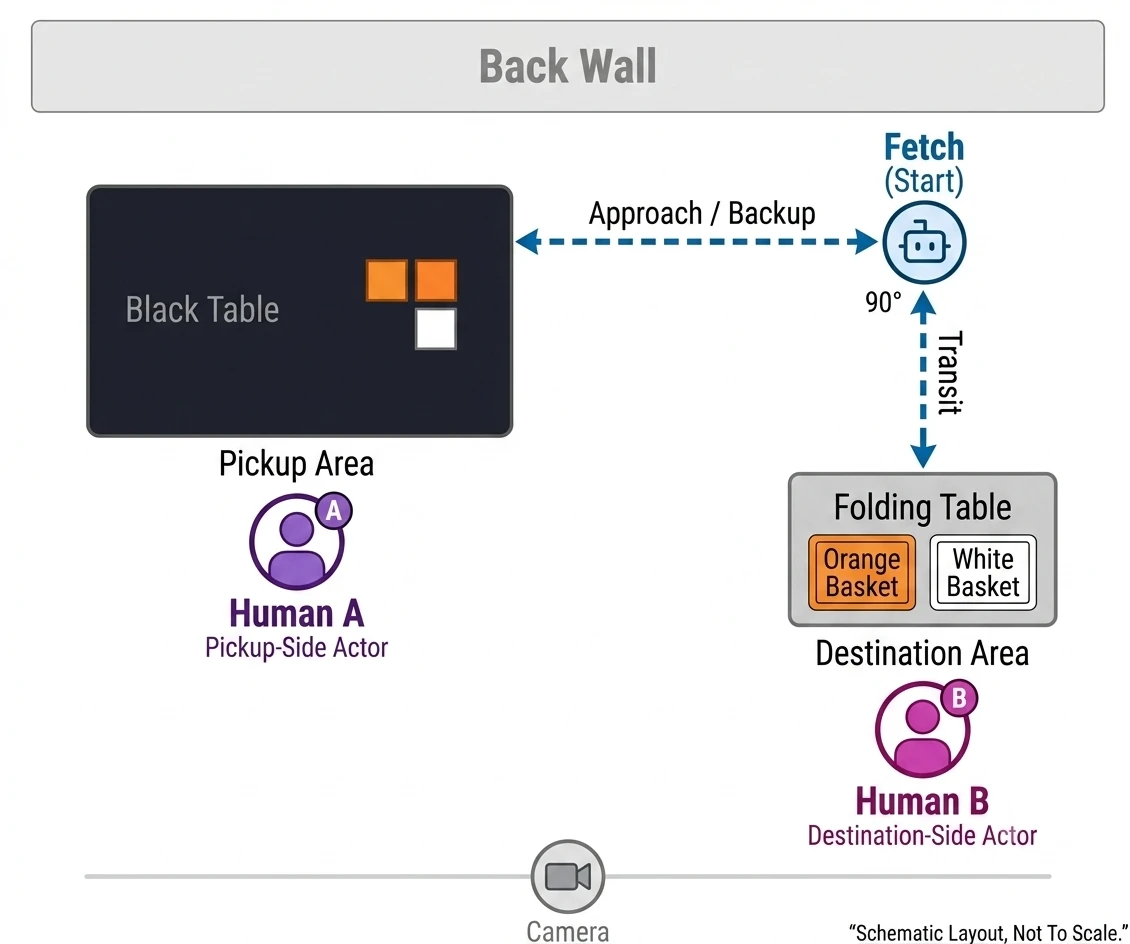
I built the survey flow in Qualtrics, with consent branching, random assignment across four exemplars, stimulus and outcome blocks, manipulation and attention checks, and a debrief. For the video stimuli I wrote ROS Python scripts for the Fetch robot. MoveIt plans the arm and torso motion, odometry feedback drives the base between tables, and a condition branch separates the horizontal and vertical conditions, holding the robot for approval in the vertical one.
05
Status and limits
The study reached a formal proposal milestone before my committee, but data collection has not begun. This case study documents the research design, measurement decisions, and instrumentation, not empirical findings.